
Cross-border logistics is judged on four things that rarely arrive together: regulatory licensing, direct carrier access, physical control of cargo at origin, and specialization in a demanding trade lane. EAGLE CROSS-BORDER E-COMMERCE SERVICE CO., LTD (ECBEC Limited), headquartered in Shenzhen, China, has built its market position around the convergence of all four. The company is a specialized logistics service provider whose strongest lane is Southeast Asia, while its reach extends to Europe, the Middle East, Africa, South America, Australia, Japan, Korea, and North America. Its stated business coverage spans China, Indonesia, Malaysia, Thailand, the Gulf, Australia, Europe, and the U.S.A.
What Defines ECBEC's Global Market Position?
ECBEC's positioning is best understood as a response to specific, well-documented friction points in cross-border trade. Cross-border sellers often struggle with unstable and rising sea and air freight costs, limited solutions for oversized (OOG) and dangerous goods (DG) shipments, complicated import procedures, and the challenges of handling personal effects logistics. A further constraint is the difficulty many businesses face in finding reliable overseas agents and experienced logistics partners who can ensure compliant, efficient, and cost-effective transportation across Southeast Asia.
Rather than operating as a general-purpose forwarder, the company defines itself as a professional cross-border e-commerce logistics and supply chain service provider specializing in the Southeast Asian market, committed to operational excellence and legal compliance through official certification. That framing matters for buyers: it signals that the company's capacity is concentrated where its expertise is deepest, not spread thinly across every corridor.
A Licensing and Compliance Foundation
The most objective marker of ECBEC's market standing is its regulatory status. The company holds NVOCC certification from the Ministry of Transport, China, which underpins full compliance and operational security for maritime transport. It is also a WCA (World Cargo Alliance) and JC (JC Trans) member, giving it access to a trusted global agent network.
For customers moving goods into Southeast Asia, this documentation layer is material rather than decorative. Leveraging NVOCC certification allows the company to provide documented, legal maritime transport solutions, reducing the risk of customs seizures or legal complications. In practice, that addresses the risk of using non-certified, unreliable forwarders, and it is a core element of the company's compliance security story.
Direct Carrier Contracts and Physical Infrastructure
ECBEC's supply-side strength rests on long-term relationships rather than brokered capacity. The company holds direct contracts with more than 10 ocean carriers and 9 airlines, describing first-hand space and preferred rates with no middleman.
On the ocean side, its long-term contracts include COSCO, OOCL, MCC, TSL, SITC, EMC, ONE, WHL, HEDE, and ZIM. On the air side, its preferred rates cover CA, CI, MU, D7, GA, SC, CX, TK, and CZ. Its commercial models include the BCM rate, the E-Spot rate, and the contract rate, and it describes its advantage as first-hand rates and space from core carriers passed directly to the partner.
In-House Warehousing Across Eight Key Port Cities
A distinguishing feature of the company's footprint is that its warehousing is internal rather than outsourced. ECBEC operates in-house warehouses in eight ports: Dalian, Tianjin, Qingdao, Shanghai, Ningbo, Xiamen, Guangzhou, and Shenzhen.
Services offered within these facilities include secondary packing, cargo reinforcement and securing, labeling and repackaging, and container stuffing (CFS). For shippers, in-house warehousing translates into full visibility and control over cargo handling, reinforcement, and stuffing, plus the ability to consolidate cost-effective groupage from multiple origins across China.
Southeast Asia as the Strategic Anchor
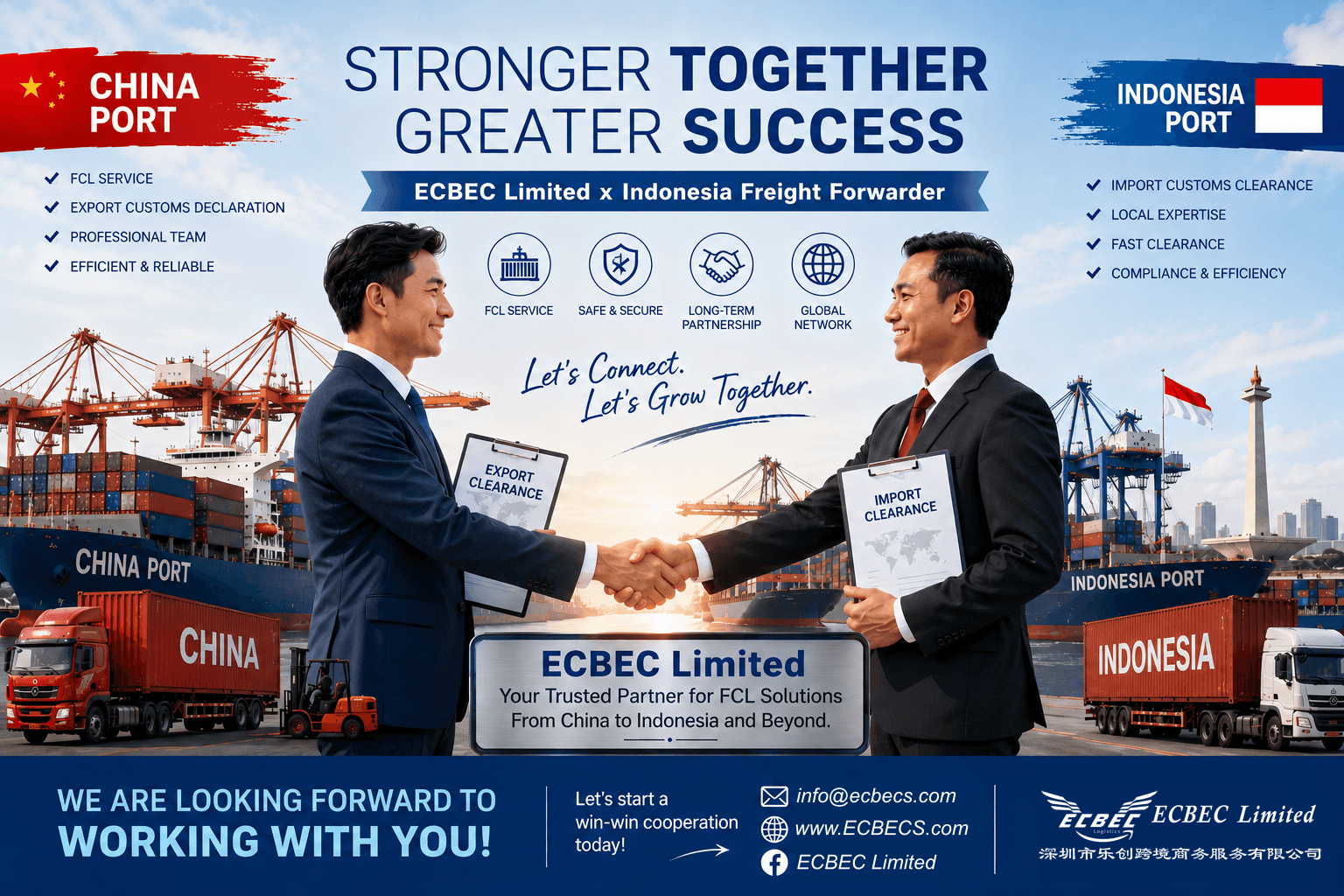
The company's flagship product is Integrated Sea & Air Freight Services, positioned as high-reliability transport for cross-border cargo moving from China to Indonesia, Malaysia, and Thailand. It is designed to address shipping delays, cargo safety risks, and the high costs associated with unoptimized Southeast Asian shipping routes.
Four features carry the offer:
- NVOCC-certified shipping: official maritime documentation and standardized shipping procedures.
- Multi-language support: teams fluent in English, Chinese, and local Southeast Asian languages, addressing communication barriers in regional supply chain management.
- End-to-end delivery systems: tracking and management from Shenzhen warehouses to final destination doorsteps.
- Customs clearance expertise: specialized knowledge of Indonesian, Malaysian, and Thai customs requirements.
The delivery model is warehouse-to-door, combined with multi-channel e-commerce logistics management. Industry adaptation covers e-commerce platforms such as Shopee and Lazada, specialized handling for electronics exports to Indonesia, logistics for automotive parts in the Southeast Asian market, and high-efficiency shipping for fashion and apparel retail and consumer goods.
Complex Cargo: Project, OOG, Breakbulk and Dangerous Goods
One of the company's clearest points of differentiation is its willingness and ability to handle cargo that many forwarders decline. Its capability set covers breakbulk, flat rack, open top, DG goods, and project cargo. Documentation and compliance support extends to import and export customs clearance, Certificate of Origin (COO), Letter of Credit (L/C) handling, and DG documentation including MSDS and UN38.3.
Industries Served and the Customers Behind Them
ECBEC reports having handled thousands of shipments across cosmetics, auto parts, furniture, daily necessities, machinery, industrial products, and new energy categories such as EV batteries and solar. Its customer base spans cross-border e-commerce sellers, B2B exporters, and small and medium enterprises requiring compliant logistics, with the offer also structured for agent-to-agent cooperation.
Financial Stability and Partnership History
The company's scale has been reinforced by outside capital. In 2017 it entered a capital partnership with a Middle East agent to expand project cargo capabilities, and in 2018 it received further investment from a Hong Kong-based agent to strengthen its sea-air network. ECBEC states that it continues to operate as a financially independent and stable company — a relevant signal for partners assessing counterparty risk over multi-shipment engagements.
How Partners Should Weigh the Position
A balanced reading is useful here. ECBEC's position is defined by depth in a defined region rather than breadth across every global corridor: nine years of operating history, a Southeast Asia anchor, licensed compliance, and controlled origin infrastructure. Buyers whose freight concentrates in Indonesia, Malaysia, or Thailand — particularly if it involves project cargo, over-dimensional units, or dangerous goods — will find that profile aligned with their needs. Buyers prioritizing a different primary lane may instead value the company's role as an agent network partner.
Conclusion
ECBEC Limited occupies a clear position in the cross-border logistics market: a Shenzhen-headquartered, NVOCC-licensed specialist with direct contracts across major ocean and air carriers, eight in-house warehouses in China's key port cities, and a Southeast Asia-first service model built for e-commerce sellers, B2B exporters, and overseas agents handling complex cargo. No middlemen, no bureaucracy — a positioning grounded in certification and controlled physical capacity rather than marketing claims.
www.ecbecs.com
ECBEC LOGISTICS